Showing posts with label The Hobbit. Show all posts

Middle-earth's Kitchen: Travel Cuisine


As a modern traveler, if there is one major thing I appreciate when flying, it’s the overpriced food places in the terminals. I know, I know--overpriced. Like outrageously so. But for me it’s totally worth having it and the hassle of airplanes as compared to what travel was a few hundred years ago (I’d love to go everywhere on horseback, though, if it were possible). Enjoying that last hotdog before heading back to Ireland for 5 months was great--and much better than cram.

Since he invented such a complete world, it’s no surprise that Tolkien included food and drink in his books. After all, he said, “'If more of us valued food and cheer and song above hoarded gold, it would be a merrier world.” And, since LOTR and The Hobbit are based around travel, there’s food for that too. No Five Guys or Starbucks like I have in my airport at home… but, close enough.

“Cram” is the main ready-to-go-in-convenient-all-new-packaging food that’s used by Bilbo and the dwarves in The Hobbit. They got it from the men of Dale, who make it as a filling, all-purpose sort of snack. According to Tolkien it was quite biscuit-like, and if you’re a fan of ancient texts on sea travel you’ll also probably recognise it as being a fictional cousin to hard tack. It was so unappealing that Bilbo and the dwarves spent time complaining about it as they went along. Honey-cake was similar but more delicious than cram, and was also mentioned in The Hobbit as being made by Beorn, although it made the consumer thirsty.

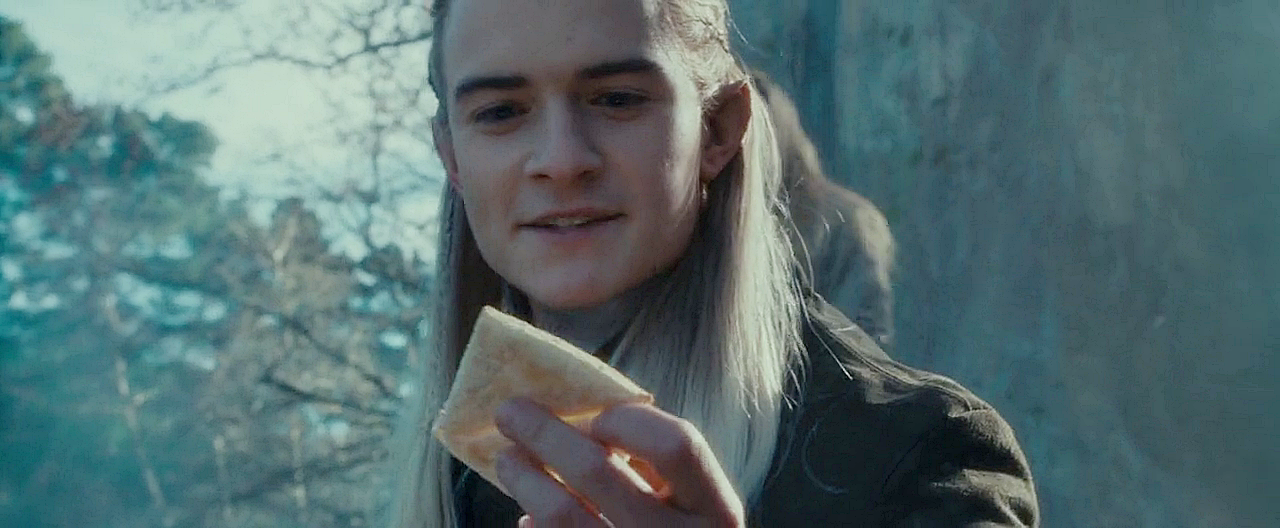
On the other hand, the wise and perfect Elves had their own version of a waybread that was good for traveling and filling one up over long distances. Lembas is the more famous, flavourful version of cram. It’s said to be more nuitritious and golden brown on the outside and cream coloured inside, and far more palatable than cram. Being made by the elves, lembas also has some interesting qualities (and not just in its ingredients, which are closely guarded and never really shared). We know that Tolkien was against allegory in his work, but that he openly admitted to using religion as inspiration for his writings (along with a lot of mythology). Lembas had a quality about it that made it very repulsive to creatures of an “inherently” evil nautre, thus why Gollum was disgusted by it and spit it out after being offered it in The Return of the King. Many have made the point that it was very similar to the Eucharist (because of the aforementioned reason), which is the ritual of taking the body and blood of Christ in the form of bread and wine in the Roman Catholic church. Like the Eucharist, which represents the spiritual bread of life, lembas sustains one’s strength and will. Tolkien apparently confirmed all of this in a private letter, which I don’t yet have a source on (if you find it in his published book of letters, let me know!).

In place of your Starbucks, ent-draught, miruvor, and the orc’s vitality potion are all good options for re-energizing in Middle-earth. The two more appealing ones, ent-draught and miruvor, are both known for being invigorating and strength-giving. Ent-draught was an ent special, and it was taken from the waters of the ent springs (which are the source of the famous river, the Entwash). Ent-draught, as far as we know, was not typically consumed by anyone other than the ents, since they were known to keep pretty much to themselves. However, Treebeard does give Merry and Pippin some upon learning that they are not “little orcs” up to mischief, and it has positive effects on them too, like making them taller and growing out their hair. The best part is that even though it’s not specifically mentioned, it’s implied that because of consuming so much ent-draught, they became the tallest hobbits in hobbit history, surpassing the 4’5” hobbit on record, Bandobras Took.

Miruvor was also said by Tolkien to be “mead” but instead of getting someone outrageously sloshed, it usually served, like ent-draught, to increase vitality and strength--like when Gandalf gave a few drops to the Fellowship on Caradhras to warm them up from the cold. Tolkien also compared it to the mythological Greek nectar of the gods, and called it a “death-defeater”. That’s the kind of stuff I’d like to have handy when I’m dying of boredom on a four-hour layover. Maybe it would pay to travel on my own two feet, like the Fellowship, and simply use miruvor for warming up my bones (I could have used it during that Irish winter). Sometimes, earlier times were simpler.

(Have you made your own Lembas before? Tell me about it in the comments, and include your favourite recipe if you can!)

Women of Middle-earth: Galadriel


Galadriel is one of Tolkien’s most complex and continually changing characters. She is by far the oldest of all the women who have a part in The Lord of the Rings, and there’s much more to her than first meets the eye. While she was important and aided the Fellowship in LOTR, things like her powerful ring, silver water basin, and colony of elves that she lived in all have interesting backstories and contribute to her status as a well rounded character.

Before we get too far into discussing the merits of Galadriel and her position as a character and woman in LOTR, first, let’s get some background information set down. There are so many things to learn about her and her family tree that take place before LOTR begins. However, it can be tricky to really get a definitive narrative on Galadriel. In The Hobbit, Galadriel was only barely mentioned (and not specifically) but Tolkien had so many other narratives and pieces of writing on her and her husband, Celeborn, and changed things so many times that it was an ever evolving storyline.
In Unfinished Tales, Tolkien’s son, Christopher, wrote:
“There is no part of the history of Middle-earth more full of problems than the story of Galadriel and Celeborn, and it must be admitted that there are severe inconsistencies 'embedded in the traditions'; or, to look at the matter from another point of view, that the role and importance of Galadriel only emerged slowly, and that her story underwent continual refashionings."
[1]
I’m sure that Tolkien, as he created Middle-earth and started weaving so many people and stories together, was constantly finding that there were things that just didn’t line up. After all, he created Middle-earth as a very real place with a very real history, so the storyline and history wasn’t flexible, and this must have been hard to keep on the right timeline. It’s said that even though Galadriel wasn’t even referenced in The Hobbit, Tolkien edited it in 1955 (the year The Return of the King was published) using his special author’s power to indirectly include Galadriel in it as a part of the White Council [2].

Galadriel was born so long before The Hobbit began that she makes most elves look like small children in comparison--yet, like all elves, she ages supernaturally and doesn’t have an end to her years. Tolkien records that she was born somewhere around 1362 (which is during the Years of the Trees. Didn’t know Middle-earth had their version of the Chinese calendar, did you? [3]), which is the First Age of Middle-earth. The Fellowship arrived in Lothlorien (Galadriel’s home) in 3019 of the Third Age, to give you some context--she’s been around for a while.
Finarfin and Earwen were Galadriel’s parents, and they were of the Noldor--basically, they lived in the Undying Lands, and Galadriel goes so far back in history that she actually had come over to Middle-earth from the Undying Lands and she is one of the last to leave Middle-earth. Among other famous relatives and acquaintances, it was Galadriel’s uncle Feanor who created the Silmarils, and she in turn was the grandmother of Arwen. Galadriel was also very close with the Maia, Melian, who taught her a lot about the history of Middle-earth (see, they passed the Bechdel test! [4]) .

So much more could be said about Galadriel’s family, friends, and travels before The Hobbit ever began (read The Silmarillion!) but for the sake of time, she and Celeborn ended up in Lothlorien, bringing a number of elves with them. Lothlorien was actually already inhabited by wood-elves, but there’s no mention of them putting up a fight against this take-over of their space (which they continued to live in).

In our next post: Who is Galadriel, the woman? What is her character? Why the special ring? There’s so much to be learned about her--I knew she was a complex character and remembered she had a long backstory, but it’s even more than I imagined and completely tangled up with the rest of Middle-earth (which is why Tolkien had some continuity issues). She was really quite an independent woman and had such a varied and interesting life, and was a leader and person in her own right. I think if everyone that criticised Tolkien’s writing as being too sexist should read about Galadriel because that would straighten things right out--whether you really love her as a character or not, she certainly deserves respect for being a well rounded, well written woman that shows Tolkien’s dedication to honestly trying to write powerful, realistic women.

Notes: First of all, if this was interesting to you, please read this entry on Galadriel (that is, if you don’t have time for the LOTR appendicies/Unfinished Tales/The Silmarillion) at The Thain’s Book. It is so interesting and chronicles the events in her life very well and clearly and has a lot more than I had time to fill in here.

[1] Unfinished Tales, J.R.R. Tolkien, edited by Christopher Tolkien. 1980.

[2] I saw this on an article about why Galadriel was included in The Hobbit films which seemed to be factually correct about Tolkien editing The Hobbit in 1955. http://middle-earth.xenite.org/2014/11/25/why-are-saruman-radagast-and-galadriel-in-the-hobbit/

[3] Nah, not really, but I thought it was funny. Although certain years really *were* the Year of the Tree, but Middle-earth calendars are a topic for another series.

[4] The Bechdel test is a sort of test to use in works of fiction such as TV, movies, and literature. Do two female characters have a conversation about something other than a man? If so, they’ve passed the test. http://bechdeltest.com

The Fangirl Experience: Meeting James Nesbitt

The Fangirl Experience is a new, monthly column suggested by Jaime Heller, featuring contributions from both our staff and our readers. Everybody has those moments when being a fangirl feels like the world has become perfectly balanced. It's those moments when you feel a stir in your heart that maybe you've made the right decision in falling down the fandom vortex. When, in the words of my good "friend" Zachary Levi, your "unbridled passion for something, or things, defines  who they are as a person without fear of other people's judgment." It's that moment you want to share with the whole world, scream to the rooftops, about what happened. Maybe it's a small moment, maybe it's a big one. But every fangirl has one--or will have one--and we would like to share ours with you. Because our Initiative would be nothing without the Experience. 


By Paige Kelly

The Lord of the Rings has always been near and dear to my heart, and thus, always a dream of mine to work on the movies in some way. My chance for being an extra in Middle-earth came and went, but I got to meet someone very involved with The Hobbit while studying abroad--and I wasn’t even anywhere near NZ!

I studied for an academic year at the University of Ulster, Magee, in Northern Ireland. During my first week there, we were given a schedule with orientation events, things such as field trips to scenic and historical sites, lectures, city tours. At the end of the week, a special meet and greet in Belfast (about 2.5 hours away from where I lived in Derry/Londonderry) was on the schedule, and from what I can remember, I think it was only a day or two before that we only found out who the mysterious celebrity was--only known as the “Chancellor” of the university. I had met my best friend a few days previously, and when we discovered that it was, in fact, James Nesbitt, we had a major bonding session over discovering we were both Tolkien fanatics. Nesbitt is a Northern Irish actor from the Coleraine area, where he still lives, and played “Bofur” in Peter Jackson’s The Hobbit film trilogy. Not only was I ecstatic about meeting someone who’d worked on these movies and met everyone involved, I had also been a fan of him earlier on in his career when he played “Leo” on the Irish television show, Ballykissangel, which I grew up watching. Meeting an actor who was involved in two of my favourite fandoms on earth?! I was thrilled and was trying to think of questions to ask all week.

Before Nesbitt, I’d never really met anyone who was a major celebrity, so I always thought that people getting starstruck was quite stupid. I mean, they’re normal people, really, as normal as me, right? So normal that they live in tiny places like Coleraine, which is not on anyone’s radar unless you’ve been in Northern Ireland a decent amount of time. But my friend and I, we just plain got excited. We couldn’t sit still the entire bus ride, and she’d stayed up the whole night before inking a drawing of Bofur for him to sign (oh how I wish I’d thought of doing that! I just hastily grabbed my closest Tolkien book and went with it). I think it could safely be said that we were the most excited out of our entire group.

At the campus in Belfast, they had a nice area set up with tables and tea and biscuits, which we were too excited to eat properly, and the room was absolutely packed out with other internationals--basically wall to wall crowds. All my friend and I’s photos are blurry and jumpy both from excitement and bouncing on our toes to see him up front at the podium. Nesbitt gave a nice short little speech, in a Northern Irish accent (I mean, duh, but most things you see him in they change it to a lighter or more English or southern Irish one), about how proud the university was to welcome new international students and what it means to them, although I know my friend and I were both thinking, That’s nice!! Now, describe, IN GREAT DETAIL, what it was like working on the set of The Hobbit. And all the people you met there.

Afterwards, he walked around taking photos and shaking hands, and my friend and I were the nerds walking around the crowd, trying to follow him, not wanting to be pushy and rude but determined not to leave without a photo. When we finally got to him, he turned around and greeted us, asked where we were from. I did most of the talking and told him how I was from North Carolina, and that I was studying in Derry at Magee. He was just as nice and pleasant as could be, very easygoing and smiling the whole time (much like Bofur, I suppose!), and told me how he was just in Derry the previous day and what a wonderful city it was (I believe he commented something along similar lines about North Carolina, but I can’t remember that part). He was very busy with lots of other photographs, but I think--and can’t remember details clearly--I told him how excited I was about The Hobbit, as he was signing my copy of The Fellowship of the Ring (I know, I know, not the same book, but like I said, it was the first thing I grabbed), and how I had loved Ballykissangel. He took a photo with us as well, and then he was off, greeting other students.

All in all, it was a fabulous day. I think my friend and I both walked off a little starstruck, giddy with the fact that we got a picture and autographs and I shook the hand that shook the hands of Peter Jackson, Ian McKellan, Martin Freeman, Orlando Bloom, Richard Armitage, Aiden Turner, Dean O’Gorman, and the list goes on and on… you know how that six degrees of separation theory thing goes? Yeah, I guess I could only say I’m 1 degree away from all those people now.

The funny thing was the local reaction to all this. My friend and I shared it with our church and new friends as a huge highlight, which I’m sure they respected, but their reactions were great--just like “Oh, Jimmy? Aye yeah, he’s just up near Coleraine.” Being such a local, his celebrity status doesn’t really affect them, regardless of the level of celebrity. I think we provided them with quite a bit of amusement and a good laugh over our fangirling. One of my friends who worked at the university there would periodically send me text messages after that notifying me whenever “Jimmy” had just poked his head in the office. It’s nice, common thing that the Irish don’t get too starstruck by celebrities and really just see them as some of their own--I guess when it’s such a small place with relatively few famous people, that’s the way it goes. Whether it was getting excited over meeting actors or bands like Rend Collective Experiment, you’d just get a shrug out of a local with a “that’s all? Sure everyone knows them, like.” They can teach you a good lesson in not getting a big head!

All in all, regardless of whether any more Lord of the Rings related films get made and I get to help out with them, I’m just glad I met one member of the cast who was just as fantastic in real life and one I’m proud to have as the chancellor of my university there. Even if I suddenly forgot every single question I wanted to ask him about filming The Hobbit. But, I remind myself, there’s always next time.  


Of course, the Fangirl Initiative wouldn't be complete without the help of you, our readers. We want to hear and feature your stories and tales. If you have a fangirl experience you'd like to share in this column, let us know

9 Signs You Are a Hobbit

Ever since I first watched the Fellowship of the Ring, I've suspected I belong in Middle Earth. At first, I thought I would be one of the Elves. Upon closer reflection, though, I have come to realize that I am in fact a Hobbit. Never mind my somewhat tall stature, I belong in Bag End.
If you have a feeling that you, too, may be one of these small Shire folk, I present 9 Signs You Are a Hobbit. 


  1. You love good food, especially taters. Mealtimes are a very important part of your day, and you would never want to be late for dinner- or breakfast, second breakfast, elvensies, luncheon, afternoon tea or supper, for that matter. 


  2. A hobbit hole means comfort, and you value comfort very much. There's nowhere you would rather be than in your favorite armchair,  among your books, maps, and doilies. Quaint, old-fashioned living appeals to you, and the Shire is just the place for such a life.

  3. You like visitors as much as the next hobbit, but you generally like to know them before they come visiting. While you are not anti-social, you do enjoy your solitude and tend to be skeptical of strangers. Sometimes you just don't want anymore visitors, well-wishers or distant relations, and would prefer to sit quietly for a while.
  4.  That said, there is such a thing as sitting quietly for too long. Although you may initially regard adventures as nasty, uncomfortable things that make you late for dinner, there is a part of you that longs to go beyond Bag End. You need some time to consider before you leave the Shire, but when you do decide to set off, everyone watch out - I'm going on an adventure!


  5. At first glance, you may not seem the likeliest candidate for an adventure. But deep down in every hobbit is an unlikely supply of courage. As all of our favorite hobbits can attest, even the smallest person can change the future, if they are brave enough. If you possess that same, sometimes surprising, courage, you might be a hobbit.
  6. You are truly loyal. When you make a promise, you intend to keep it. Throughout the Hobbit and the Lord of the Rings stories, we see hobbits illustrating this time and again. Bilbo is initially wary of his unexpected guests, but in the end, he will do anything to come to their aid. Sam sticks with Frodo through thick and thin, even though Frodo repeatedly tries to handle matters himself; Merry and Pippin also refuse to let Frodo go it alone. Frodo himself stays the treacherous course, remaining true to his promise and duty as the ring bearer. If you would go to Mordor and back again for your friends or something you believe in, you possess the loyalty of a hobbit.

    “You can trust us to stick to you through thick and thin – to the bitter end. And you can trust us to keep any secret of yours – closer than you yourself keep it. But you cannot trust us to let you face trouble alone, and go off without a word. We are your friends, Frodo. Anyway: there it is. We know most of what Gandalf has told you. We know a good deal about the ring. We are horribly afraid–but we are coming with you; or following you like hounds.”  - Merry Brandybuck 
    ― J.R.R. TolkienThe Fellowship of the Ring

    Sam
  7. Elves, dwarves and men- you are able to get along with them all, once you get to know them, An individual's background doesn't matter to you; their character does. This example inspires others to put aside prejudice and join in a greater company or fellowship.
  8. Though gold can be useful, you are have a pure heart and are not greedy for treasure. Some hobbits have been corrupted, but overall, most hobbits value food and cheer far above gold. You are, however, somewhat protective over your spoons. I personally became quite defensive when my favorite spoon was nearly discarded. Those dratted Sackville-Bagginses!
  9. There is no place like home. No matter how far you travel or how your adventures change you, the Shire is always beckons you to come back again- just like the stories of Middle Earth.


    Are you a hobbit after all? If so, remember that if you ever pass through Bag End, tea is at four. You are welcome any time. Don't bother knocking.

    -- Sarah Rose

Keep Watching Over Durin's Sons


It’s almost too bad Tolkien didn’t create a dozen dwarves, otherwise we’d have one for each day of the 12 days of Christmas. However, since there are the twins Fíli and Kíli, I suppose they can count as one day. There’s not many posts left till Christmas, and The Battle of the Five Armies comes out in 3 days, but let’s discuss as many of the dwarves of The Hobbit as possible!

Reference to dwarven family trees is only made a couple of times in Peter Jackson’s film adaptations, and most of what movie-goers know is that Fíli and Kíli are Thorin Oakenshield’s nephews. They are all the direct descendents in the line of Durin; but there are also a few others in the company who are related as well. And those who aren’t are all related to some of the other dwarves in some way. With Christmas fast approaching and most of us preparing to host or visit family, would you trade that for a Durin family Christmas? (I mean, if it meant being in Middle-earth, I might take it. But on the other hand, I personally don’t like having a scratchy chin or spending a lot of time indoors/underground. Give me sunlight…).

What/who is the line of Durin, anyhow? Tolkien was a master at creating so many backstories and history, turning over (almost) every rock and giving us a lot of lineage and family tree information on the races in Middle-earth. Durin’s roots go right back to the foundations of Middle-earth. If you’re really interested in all the backstories and roots of this, go find a copy of The Silmarillion. To keep it short and simple (for now!), there were seven original dwarves created for Middle-earth by one of the Valar. The Complete Guide to Middle-earth describes the Valar as the “fourteen greatest (excluding Melkor) of the Ainur who chose to enter Ëa to fulfill the Vision of Ilúvatar” [1] (Ëa referencing the earth). Basically, the Valar are angelic servants (that take on physical form) of the creator, Ilúvatar. Aulë was the particular Valar who created the dwarves, Durin being one of the first seven.

From Durin, some of his most famous descendents came--Thorin (the second) and Fíli and Kíli (sons of Thorin’s sister), but also a few who made an appearance in The Hobbit and The Lord of the Rings. Balin, Dwalin, Óin, and Glóin were all on the family tree, although they were not as close genealogically to Thorin’s side. Balin and Dwalin were both brothers, as were Óin and Glóin. And--if you’ve kept careful watch in The Hobbit or anywhere in the books--Gimli is included in this family tree as well. Not only were the thirteen dwarves companions and comrades in arms, they shared a lot of Durin’s royal blood.

Tolkien didn’t write much about Thorin, his folk, and their traditions and life outside of his main works, especially before their quest, where we see most of their character development. After his grandfather being killed and the dwarves chased out of the mountain by Smaug, Thorin and Durin’s Folk eventually settled in the Blue Mountains until their quest began. Tolkien simply refers to this area as “Thorin’s Halls.” In both names and culture, we see Tolkien borrowing a lot from ancient Norse mythology and poetry, but you have to search his additional histories to piece together exact details. The same is true for the dwarves, even though you will find even less details on them--not even the only dwarven twins recorded in Tolkien’s histories are given much of a personality in The Hobbit. For all its faults pointed out by Tolkien purists, Jackson’s movies do a nice job of fleshing them out, paying particular attention to Kíli in particular. But the strong family ties are portrayed well; the twins are fiercely loyal to Thorin, and Fíli in particular is being trained to take over as the heir to the throne someday. Both brothers, like Thorin, possess stubborn pride (a very dwarf-like trait, it seems to me; or perhaps even more apparent in Durin’s Folk?) and loyalty to each other, which is a great portrayal of the dwarven race. It is rare to meet a Tolkien fan whose favorite race and obsession is the dwarves; even though many of us appreciate them, I’m pretty sure most of us would sign up for being elves without a second thought to what being one would really be like. There is something to be said for dwarves though. For all their pride and stubbornness, obsession with lineage, and hoarding of treasure, we see in both the movies and books both Durin’s Folk and other descendents of the original seven staying true to each other. There is a bond of brotherhood there, and as much as they seem to love their treasure I think when pushed, these dwarves would choose kin and friend immediately.

Durin’s line ended not long after Thorin was gone with Durin VII, a direct descendent and the last one, and as detailed as Tolkien usually got, the only explain that the world was growing old and the time of the dwarves was ending. We may see Jackson do something different than the inevitable ending of The Hobbit in his last movie (which most of us think has to happen, but also dread it. Tears will be shed) but other than the line of Durin being changed, I don’t see it as having any other real effect upon the dwarven race. Sure, there could be speculation about how Thorin’s character could change, or if the line would be continued longer, but I think the biggest change will be how the War of the Ring would be affected--and for Jackson to continue true to his adaptations of The Lord of the Rings, he can’t steer too far from the original. In The Lord of the Rings, we don’t see large numbers of dwarves, due to Sauron’s takeover of Middle-earth (the destruction of the dwarven settlement lead by Balin in the Mines of Moria being one of the disastrous effects)... and I wonder if Thorin had been around, if things would have been different. I have a feeling that he may have been entrenched in his mountain, protecting and hoarding his riches, even if Sauron’s forces came for him as well.
If you ever come to a point where you realize your hoarding and coveting habits are becoming too dwarf like, remember to stop before it’s too late and your greed backs you into a corner with no conceivable story plot out other than the inevitable, like poor Thorin. Tolkien’s work contains a lot of good life lessons, one of them being that the things that we want to last the longest either won’t fulfill us or they will outlast us--so choose wisely. And be thankful that you aren’t one of Durin’s doomed line.

Footnotes: 
[1] Foster, R. (2001). The complete guide to Middle-earth: From the Hobbit through the Lord of the rings and beyond. New York: Ballantine Books.

Middle-earth: A World of Music


For all their cultural differences, almost every race in Middle-earth has a connection to song and music. The elves, of course, are portrayed in the Lord of the Rings trilogy as having perfected the tradition, being as it was that it was handed down by their creators, the Valar.

Tolkien, always a linguist, not only created a world with complex and legitimate languages, but he included music in his work as well. Not only did music give Middle-earth more dimensionality but it also tied it to earlier works of mythology and continued the tradition of poetry and epic tales within melodies. Music, it can be argued, was the basis for Middle-earth; The Silmarillion begins by describing the “music of the Ainur” which was what formed the world. The Elves, the first inhabitants of Middle-earth, are most frequently mentioned as singing or reciting poetry; but the dwarves prove their vocal power by singing “That’s What Bilbo Baggins Hates” in The Hobbit as well as their famous song, “Far Over the Misty Mountains Cold” (even accompanying it with instrumentals).

These two dwarven songs are famously featured in Peter Jackson’s film adaptations of The Hobbit. For any fans of the movies, whether the original trilogy or the new Hobbit trilogy, music features strongly and helps create a vivid, three dimensional Middle-earth. It’s interesting to discover, though, that before actors and pop stars were singing these songs on the big screen, Tolkien himself, quite a renaissance man, recorded a few versions himself. Wouldn’t it have been a treat if they included some tribute to that in the last Hobbit film? We don’t have too long to find out… (my opinion is they won’t, but hey, one can dream).

Have a listen to Tolkien singing “That’s What Bilbo Baggins Hates”


And compare to the scene The Hobbit: An Unexpected Journey:


The film version is rounded out by multiple dwarf voices singing, their jubilant smashing of cutlery, and with a score in the background that gives a really Celtic-influenced feel to the whole song. Still, all things considered, it’s quite charming hearing the song from the person who wrote it and who was the mastermind of Middle-earth. Youtube is a great resource for the nerdy Tolkien fan; there are a good number of recordings of the Professor reading excerpts of his work and reciting poetry.

Personally, even though we can argue over the different ways in which Jackson changed Middle-earth in these recent adaptations, I think many of us can agree that the music has been well done and kept as a beautiful tribute to Tolkien’s world. Even original songs, such as “I See Fire” by Ed Sheeran, have a touch of Middle-earth, both in the style of the instrumentals and the lyrics. “Keep watching over Durin’s sons” is a line that’s not dumbed down to say “all those dwarves who went to slay a dragon and reclaim their homeland” but instead, for the LOTR historian/geek, references their lineage (good job, Ed). I think Professor Tolkien would be proud to hear these original songs, so poetic are they in their own right; not simple pop lyrics but songs like Sheeran’s tell the story using the theme of fire.

And, last but not least, if you haven’t heard Billy Boyd’s (Pippin) song which has been making the rounds these past couple of weeks, it’s high time to give it a listen (bring some tissues). It’s obvious that it’s a last goodbye because if you’ve read The Hobbit you know what happens at the end; but I think another aspect of it is that it’s a last goodbye for all of us fans and lovers of Middle-earth. Unless Jackson magically gets the rights to The Silmarillion, it looks like The Battle of the Five Armies is our last look into Middle-Earth. For a lot of us, these films have spanned more than half the course of our lives, and it’s an alternate universe that is apart of our lives. It’s fitting to have a song to commemorate that; one that’s in the style of the beautiful poetry that Tolkien loved and built Middle-earth on, and one that’s a bittersweet farewell to a beloved series. As Gandalf said, I will not say all tears are an evil--but (another blog for another time), it’s never really farewell when we have such a beautiful and detailed universe to return to time after time, complete with the music that binds it together.